
Featured Researcher Bio - Ruth Dill-Macky 2026
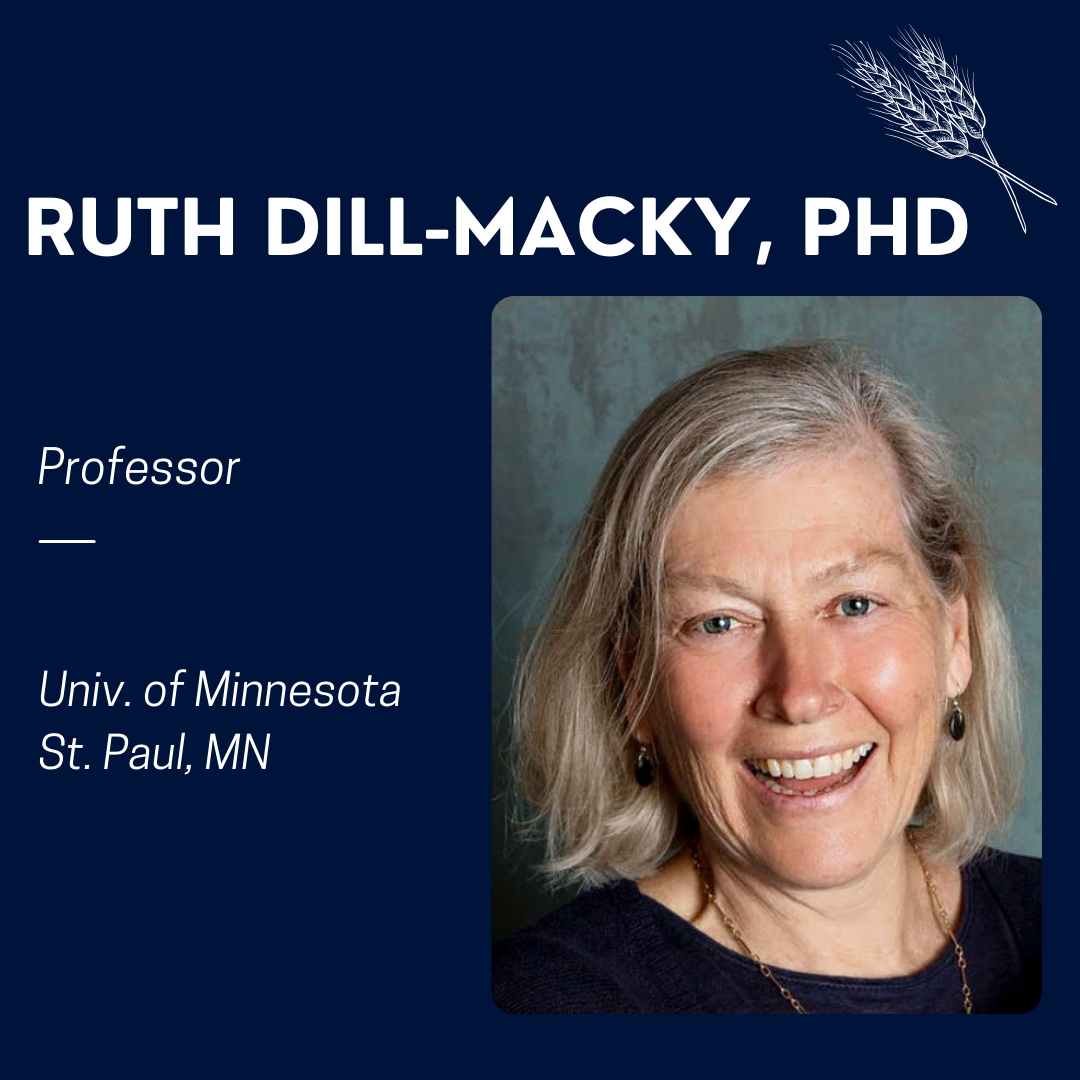
Meet Ruth Dill-Macky, a professor of small grains pathology in the Department of Plant Pathology at the University of Minnesota. Dill-Macky has been an integral part of the USWBSI since its inception, holding a variety of key leadership positions, most recently completing her term as USWBSI’s Researcher Co-Chair. Her internationally recognized research on FHB has focused on management strategies, epidemiology, and field testing of lines for resistance.
An Interest in Biology Leads to Cereals Research
Dill-Macky grew up in southeast Queensland, about halfway up the coast of Australia. Growing up she was always interested in biology, and she loved animals. While in high school, she volunteered as a veterinary technician and a zoo keeper. She attended the University of Queensland (UQ) in Brisbane, Australia, where she was contemplating majoring in marine biology. She took many zoology classes but then discovered botany. She took all the botany classes UQ offered and her final class was plant pathology. She performed so well in that class, her instructor, J. A. G. Irwin, offered her the opportunity to complete her Honours degree, a one-year post-graduate program, with him. After earning her bachelor of science degree majoring in botany and biochemistry, she completed her Honours at UQ researching Stemphylium leaf spot, a foliar disease of alfalfa.
Following the completion of her Honours degree, she applied for and accepted a position as a research scientist with the Queensland Department of Primary Industries (QDPI) at the Queensland Wheat Research Institute (QWRI) in Toowoomba, Queensland, working on stem and leaf rust of barley. Shortly after starting, she enrolled and began her Ph.D. at UQ, this time as a remote, part-time student. At the QWRI, the research was focused on wheat and barley production. In this role, she had regular interactions with other pathologists, cereal chemists, breeders, soil and weed scientists, as well as agronomists. After finishing her doctorate degree, she moved to the U.S. to pursue a two-year post-doctoral position on stem rust at the USDA-ARS Cereal Rust Lab (now the Cereal Disease Lab) located in St. Paul, Minnesota, with Alan Roelfs.
A Front Row Seat to Managing FHB
Dill-Macky arrived in Minnesota in 1992. In 1993, the state’s wheat crop was heavily impacted by FHB. This was the beginning of the reemergence of FHB in the U.S. At the time, the small grains pathologist position at the University of Minnesota was vacant. Concern over FHB prompted growers to approach the University to refill the position. Dill-Macky interviewed in early 1994 and joined the faculty in the Department of Plant Pathology in June of 1994.
She started working on FHB right away and was involved in the regional (MN, ND, SD, and Manitoba) meetings the preceded the establishment of the USWBSI. She attended her first regional FHB meeting held in Fargo, ND in 1994 and organized the first National FHB Forum, held in St. Paul in 1997. She has since served on the USWBSI Steering and Executive Committees from 2002 to 2025 and was elected as the Researcher Co-Chair in 2018.
As the Researcher Co-Chair, Dill-Macky lead the Initiative through several challenges including most recently providing guidance for the FY25 federal funding changing circumstances. “I worked – along with many others, especially our amazing stakeholders – to guide the Initiative through these turbulent times,” said Dill-Macky. She is honored to have served as the Researcher Co-Chair for the past eight years working to facilitate the Initiative’s priorities, liaise with stakeholders, and be a voice to the public as well as with state and federal legislators.
Through all the challenges, from Dill-Macky’s perspective the USWBSI community is what makes it all worthwhile. When the USWBSI first started, much of the research was siloed within the states. The reaction of wheat and barley germplasm to FHB was so variable, it was determined a collaborative effort was needed. Dill-Macky witnessed the establishment of the screening nurseries and since then has facilitated and observed many more collaborations.
Now with a better understanding of the pathogen and the tools to manage it, Dill-Macky is certain that the researchers of the USWBSI will continue to make critical improvements to host resistance, fungicides, and management practices to aid farmers in managing this disease.
An Appreciation for Setbacks as Part of the Process
Dill-Macky’s guidance for graduate students and post-doctoral researchers is to learn that disappointment is part of the process but never give up. Over the course of a career, grants will get denied and articles will need to be rewritten, but she encourages viewing these setbacks as a challenge to improve rather than roadblocks impeding progress. In addition, she advises recognizing that most scientific research is collaborative and lean into those collaborations. Finally, give back and pay it forward whenever possible.
For more information about Dr. Ruth Dill-Macky’s research, visit her faculty page.
To learn more about others in the FHB community, check out all the previous USWBSI Featured Researchers/Advocates.