
Featured Researcher Bio - Rick Boyles 2026
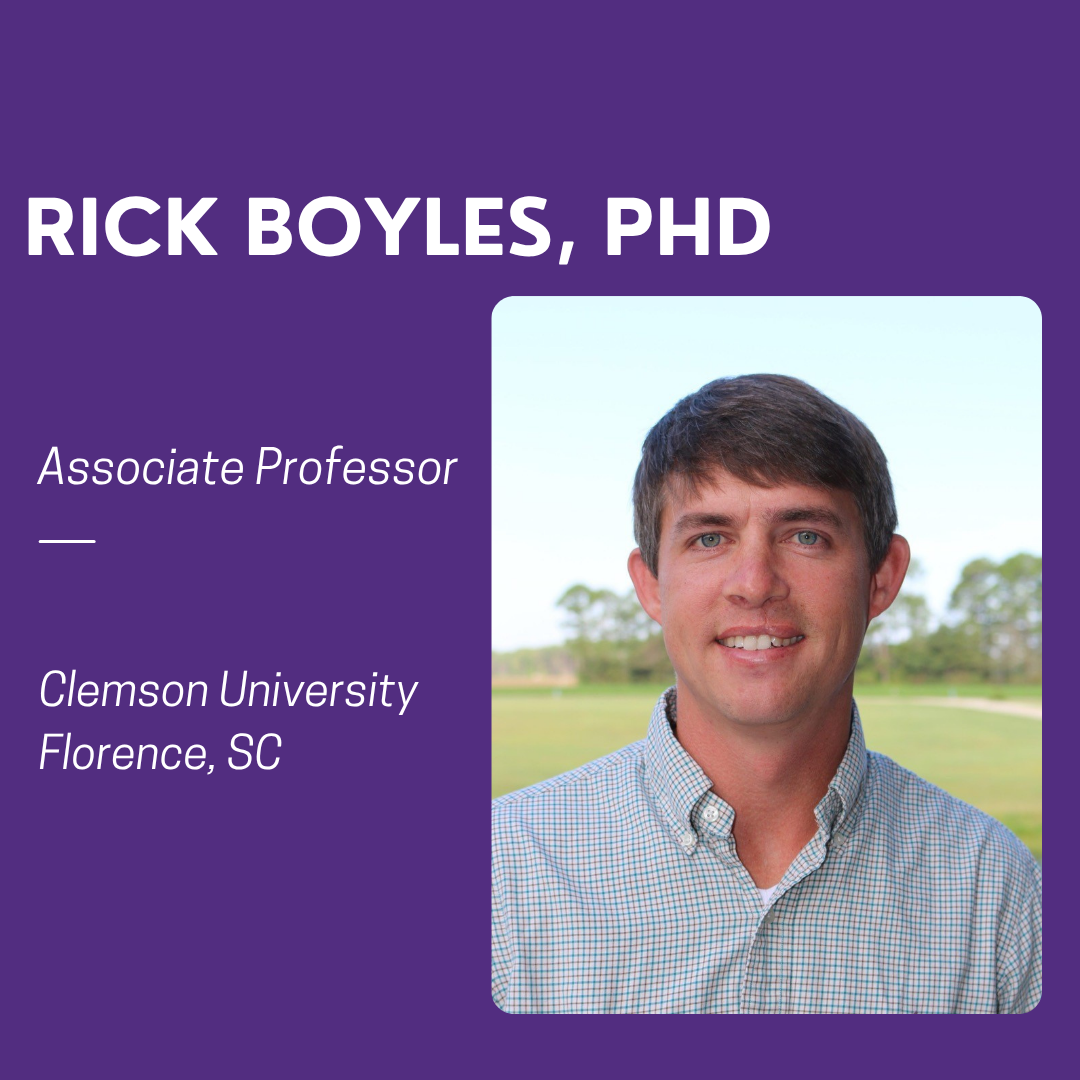
Meet Rick Boyles, an associate professor of cereal grains breeding and genetics in the Department of Plant and Environmental Sciences at Clemson University. Boyles has been funded by the USWBSI since 2018 and currently serves as the Variety Development and Host Resistance (VDHR) – Southern Winter Wheat Coordinated Project committee chair. His research focuses on developing FHB resistant soft red winter wheat varieties for the Atlantic Coastal Plain and greater southeastern U.S. through the use of traditional phenotyping and modern technologies such as genomic selection and doubled haploids.
Making a Positive Difference for Agriculture
Boyles grew up in Barnwell, South Carolina surrounded by farms but, not raised on one. He attended the University of South Carolina with the intent of going to medical school and following in his father’s footsteps. However, after a short summer position working in healthcare, Boyles felt practicing medicine wasn’t the best fit for him. He quickly pivoted into research and landed in plant sciences because agriculture was vital to the community where he was raised. He thought that this path could allow him to make a positive difference by developing new crop varieties for the farmers in the state of South Carolina and the broader southeastern U.S. He earned his bachelor of science degree in biology and then attended Clemson University for his doctorate degree. His PhD focused on conducting genetics and pathology research in sorghum, a cereal that is less prominently grown in the U.S. but a staple in sub-Saharan Africa and parts of Asia.
Breeding FHB Resistant Varieties Using Traditional and Modern Methodologies
Eight years ago, Boyles received a small amount of funding from the USWBSI to initiate an inoculated FHB screening nursery as part of the VDHR Southern Winter Wheat Coordinated Project. This funding was important as it allowed Boyles and his team to kick-start the screening of elite varieties, advanced breeding lines, and diverse germplasm for FHB resistance. Further funding throughout the years has been critical for continuing to advance his wheat lines for FHB resistance.
While he leverages tools like genomic prediction and doubled haploid technology to aid him in developing FHB resistant cultivars, his favorite aspect is walking the FHB nursery headrows to rate advanced lines and screen his breeding material for resistance before they enter into yield testing. “This state of ‘where the rubber meets the road’ is always exciting, and I enjoy the competition of trying to develop more FHB resistant lines than my close colleagues,” said Boyles.
Boyles’ program was one of the first to adopt an image-based phenotyping method to estimate Fusarium-damaged kernels (FDK) in wheat. Using the Vibe QM3 Grain Analyzer, his team found that a calibration that factors in the length, width, and color of individual kernels after imaging could reliably discern between a healthy and diseased kernel. This has led to an objective screening tool that avoids individuals estimating the percent FDK based on various standards. He now relies solely on the Vibe QM3 to generate FDK for every FHB sample collected from the field each year.
Boyles believes FHB will never be completely eliminated as fungal pathogens have the ability to overcome plant resistance mechanisms. He still worries that a major shift in pathotype for this disease could cause virulence on the most effective genes currently deployed in new varieties. He is also concerned that the increase in erratic weather patterns during flowering when the pathogen infects and then spreads could make outbreaks harder to forecast thus, creating more pressure on host plant resistance. However, he does expect FHB outbreaks to decline as more farmers adopt cultivars with moderate resistance and management practices that reduce pathogen spread. As the breeding programs continue to release new cultivars, he’s hopeful a higher percentage of acreage will shift towards more FHB resistant varieties to mitigate pressure.
Learning Through Listening, Observing, and Doing
Boyles recommends spending a considerable amount of time meeting in person with other plant breeders across various stages of their careers. “You will likely learn more about cultivar development in 30 minutes from a conversation with an established breeder than by reading an entire textbook,” said Boyles. These conversations, especially the ones happening when walking through field nurseries, often spur ideas for new projects and experiments. In addition, he suggests making time to learn pedigrees, field designs, management, and other practical tools (i.e. operating a combine) that most plant breeders will need to know in order to run a successful cultivar development program.
For more information about Dr. Rick Boyles's visit his faculty page.
To learn more about others in the FHB community, check out all the previous USWBSI Featured Researchers/Advocates.