
Featured Researcher Bio - Alyssa Collins 2026
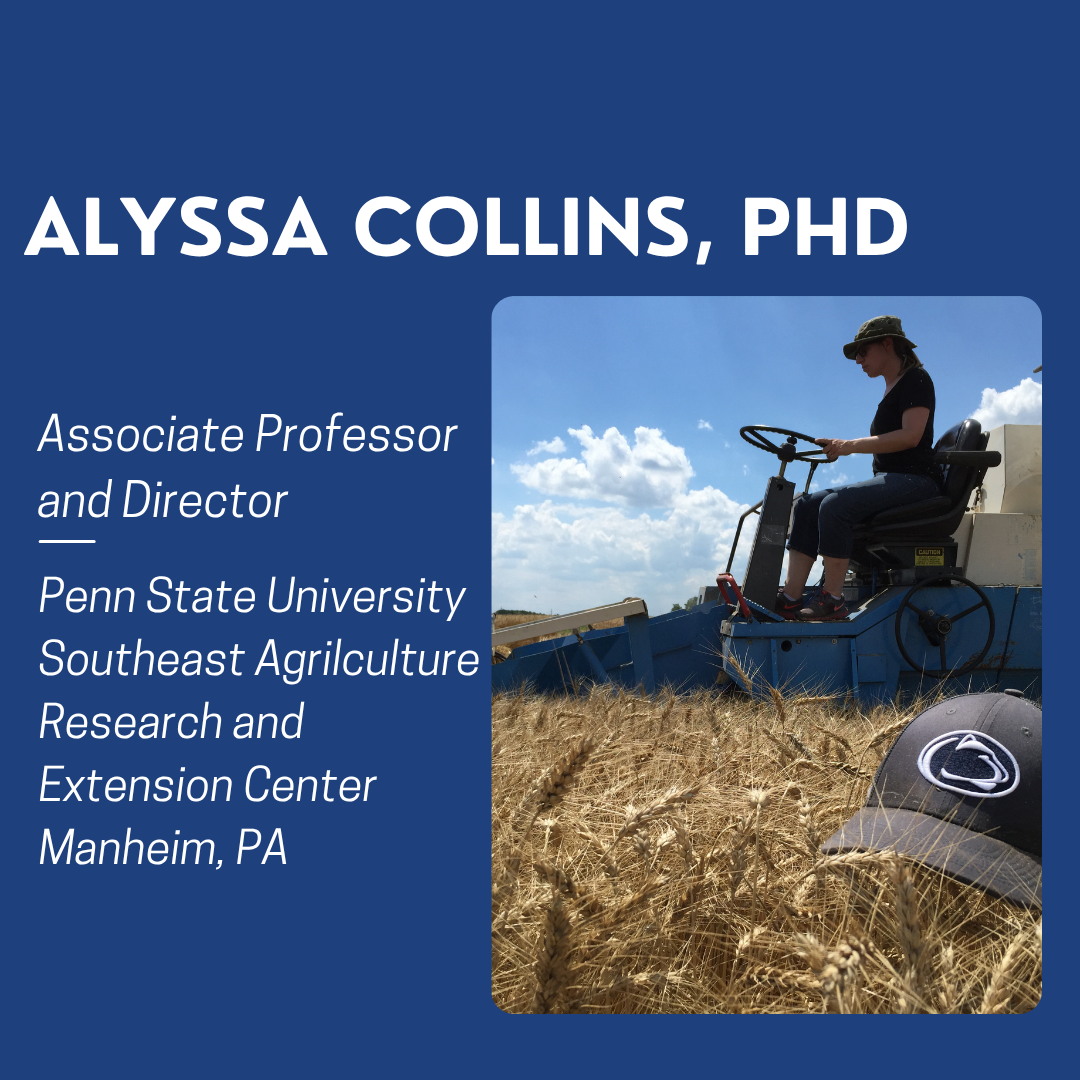
Meet Alyssa Collins, an associate research professor and the director of the Southeast Agricultural Research and Extension Center at Pennsylvania State University. Collins has been funded by the USWBSI since 2015 and has served as the Forum Organizing Committee (FOC) chair, and is currently a member of the FOC and of the Steering Committee representing barley pathology. Her USWBSI-funded research is part of the Integrated Management Coordinated Project and focuses on developing integrated management strategies and evaluating fungicide efficacy against FHB (scab) in barley for Pennsylvania and the Mid-Atlantic region.
Applying Field Research to Aid Farmers
Collins was born and raised in southern New Jersey, and during the summers, she would spend time on her grandparents’ blueberry farm. She attended Rutgers, the State University of New Jersey, never intending to pursue agriculture, but a summer position as an integrated pest management scout showed her that one person can have a large impact on farmers by providing tools that allow them to keep their crops healthy while reducing their pesticide use.
She earned her Master of Science degree in plant pathology from North Carolina State University, where she realized she preferred fieldwork to laboratory work and enjoyed addressing problems in agricultural systems rather than studying a single disease on one crop. She then earned her Ph.D. in plant and soil sciences from the University of Delaware, where she studied cover cropping as a method to reduce plant disease in pumpkins. She continued as a postdoctoral researcher, working on agronomic nutrient management.
Collins was hired as the director of the Penn State Southeast Agricultural Research and Extension Center, an experiment station in the heart of Pennsylvania’s most productive farmland. In this role, she supports field research and extension for many programs across the College of Agriculture as well as getting to do her own applied research and plenty of extension education. When asked who inspired her most to work in this field, Collins said, “It was really the farmers I met along my journey, starting with that first job counting bugs. I thought I was working for them, but they shared their knowledge so generously and I learned so much from them that I couldn’t help but want to make their lives better and their crops more successful.”
Building Awareness and Educating through Extension
In 2014, Collins received a call from Mike Davis, former president of the American Malting Barley Association, who was looking for researchers in the Northeast to work on FHB in barley. Davis was very convincing and a few months later Collins attended her first National Fusarium Head Blight Forum and signed on to conduct integrated management trials in Pennsylvania.
Collins views being part of the USWBSI as a gift because so many researchers from different fields are working together to solve a critical problem within a single pathosystem, with support from producers, industry representatives, and legislators. “The community, all striving toward the same goal, is what is unique and wonderful about this Initiative,” said Collins. Her favorite part of the Initiative is finding new ways to expand the scope of the work the Initiative does across the greater landscape of agriculture. As the Initiative continues to grow, she believes it’s important to make sure that research is being done in the context of the reality of farming systems. For instance, understanding and manipulating the dynamics of corn production can have a significant influence on how much Fusarium inoculum is dispersed, ready to infect wheat. In addition, the choices farmers make in non-small grain crops can directly impact wheat and barley, and learning what these “buttons” are allows researchers to reduce the risk of FHB and revolutionize their approach to plant health.
Building awareness of FHB among farmers and the agricultural industry as well as connecting them with the great tools the USWBSI is providing is Collins’ biggest accomplishment related to scab research. In the last several years, the questions she has received have become more sophisticated and nuanced, showing that more and more farmers and advisors are understanding pathogen biology and management intricacies and they are striving to meet the needs of this dynamic system.
Collins believes that FHB will continue to require constant attention and innovation. Future short-term challenges will very likely involve the complications of variable climate conditions and how that affects our ability to predict and respond to outbreaks. She thinks that, as time progresses, decision-making tools and genetic resistance will become more advanced and responsive as machine learning is incorporated into the existing well-vetted strategies.
Keeping an Open Mind
Collins’ advice to graduate students and postdoctoral researchers is that there will come a time when you need to curate your career and prune out some interests and paths, and that will come quickly. But in the meantime, take this time to say “yes” to opportunities while you can, even if you don’t see the immediate relevance; follow where it leads for a while. You never know what those wide-ranging experiences will provide you in terms of skills, knowledge, and connections.
For more information about Dr. Alyssa Collins' research, visit her faculty page.
To learn more about others in the FHB community, check out all the previous USWBSI Featured Researchers/Advocates.