
Featured Researcher Bio - Xiwen Cai 2026
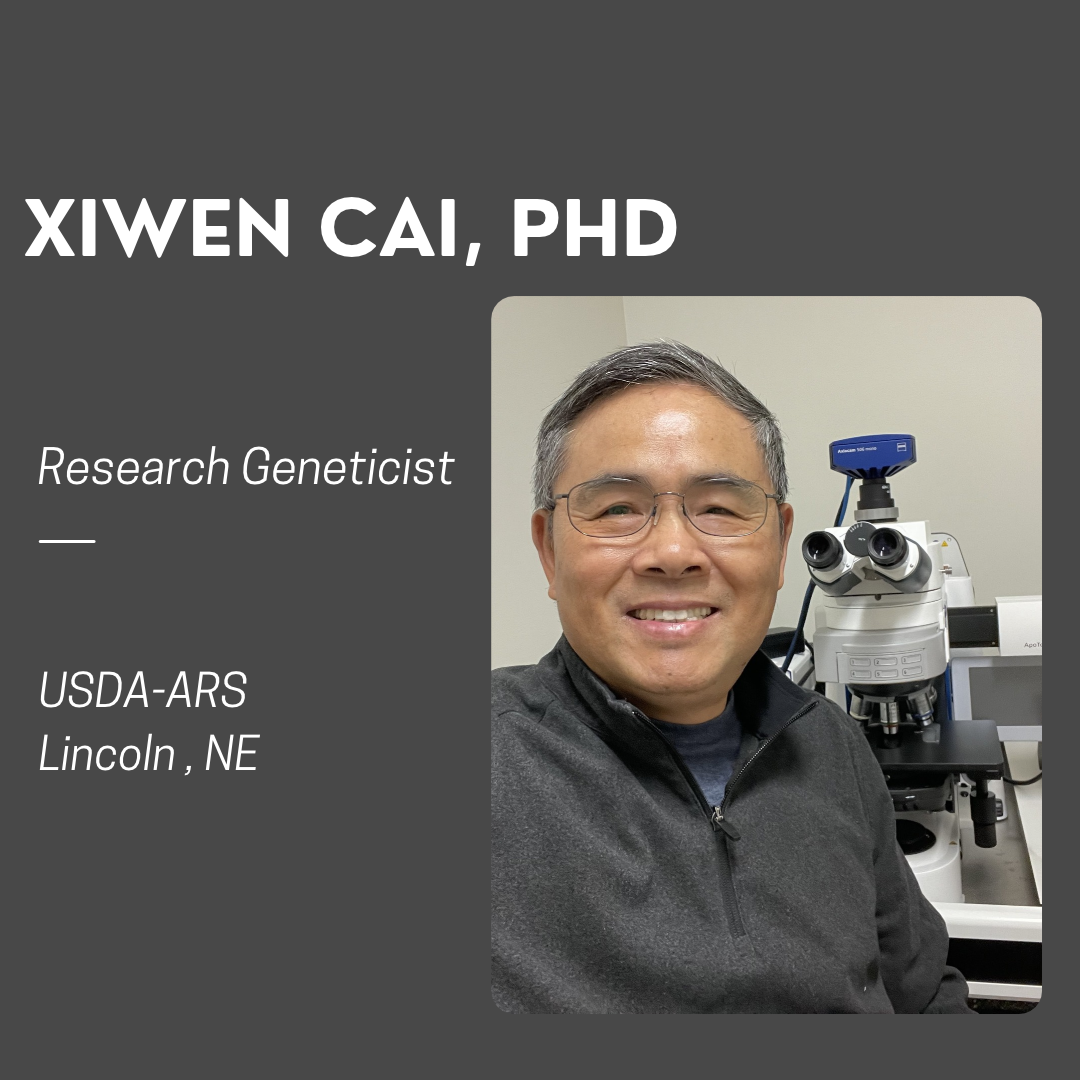
Meet Xiwen Cai, a research geneticist with the USDA-ARS Wheat, Sorghum and Forage Research Unit in Lincoln, Nebraska. Cai has received funding from the U.S. Wheat and Barley Scab Initiative (USWBSI) since 2003. His USWBSI-funded research, as part of the Durum Coordinated Project (DUR-CP) and the Variety Development and Host Resistance Spring Wheat Parents Coordinated Project (VDHR-SPR CP), focuses on introducing new sources of resistance into durum and spring wheat backgrounds. During his time with the USWBSI, Cai has served on the Executive and Steering Committees, as the Chair of the DUR-CP, as well as in other volunteer roles.
Creating a Career in Cytogenetics
Cai grew up in a rural area, which motivated him to pursue work that could benefit farmers and improve their living conditions. He attended Huazhong Agricultural University, where he received a bachelor of science degree in agronomy. He then attended Nanjing Agricultural University, earning a master of science degree in wheat cytogenetics. His mentor, Dajun Liu, provided exceptional training in cytogenetics and plant breeding. This mentorship inspired Cai to continue working in the field of cytogenetics for more than 40 years.
Later, Cai decided to move to the United States, where he attended Washington State University and earned his doctorate studying wheat genetics and breeding under the advisement of Stephen Jones, the university’s winter wheat breeder. His research focused on cytogenetic analysis and chromosome engineering of wheat and the wheat-related wild species Thinopyrum ponticum and Thinopyrum intermedium. His work explored alien introgression of resistance to Cephalosporium stripe disease and perennial growth habit into wheat.
The accomplishments and training he gained during his time at Washington State University encouraged Cai to continue his research in this field and motivated him to pursue a career as a researcher and educator of plant breeding and genetics.
Cai joined the faculty of North Dakota State University as an assistant professor in 2002. During his time there, his research focused on cytogenetics, chromosome engineering, alien introgression, and the breeding of wheat and related grasses. In 2021, he accepted his current position as a research geneticist at the USDA-ARS.
Developing and Deploying New Sources of FHB Resistance
After more than two decades of involvement with the USWBSI, Cai enjoys the valuable interactions at the annual National Fusarium Head Blight Forum. He also has gained important insights from the regional workshops organized by the USWBSI where a focused group of researchers plan and coordinate their research activities.
Cai’s favorite FHB projects are those in which he can identify, introgress, and characterize wild-species-derived FHB resistance in wheat and barley. The introgression of the Thinopyrum elongatum-derived resistance gene Fhb7The2 has been one of his favorite projects. In fact, he considers this project his greatest accomplishment in FHB research. During the project, Cai and his research group incorporated Fhb7The2 into the wheat genome using genomics-enabled chromosome engineering. They then released the Fhb7The2 introgression, along with associated markers, for use by breeders. Finally, Fhb7The2 was deployed and stacked with other major resistance genes into durum and wheat genotypes to support the development of FHB-resistant germplasm and varieties.
During the project, Cai and his research group incorporated Fhb7The2 into the wheat genome using genomics-enabled chromosome engineering. They then released the Fhb7The2 introgression, along with associated markers, for use by breeders. Finally, Fhb7The2 was deployed and stacked with other major resistance genes into durum and wheat genotypes to support the development of FHB-resistant germplasm and varieties.
As a researcher, Cai believes FHB will remain a persistent threat to wheat and barley production until an effective, complete control strategy can be developed. To date, only partial host resistance has been identified and deployed in wheat and barley. One of the biggest challenges researchers face is the lack of effective resistance sources that are useful in wheat breeding. Therefore, continued FHB research is crucial for identifying and generating new sources of effective resistance and strengthening and diversifying resistance to FHB in wheat and barley.
Learning to Value Persistence in Research
When it comes to providing guidance to the next generation of researchers Cai has some basic advice.
“Expected success leads to the accomplishment of your research goals, but unexpected failure sustains your success.”
Advancing FHB Resistance through Breeding
Cai will be presenting at the 2026 National Fusarium Head Blight Forum on Monday, December 7, 2026, in Louisville, Kentucky. His presentation, titled “Introgression and Development of Thinopyrum elongatum-derived FHB Resistance Gene Fhb7The2 in Wheat and Barley,” will examine how Fhb7The2 was deployed into adapted durum and common wheat. In addition, he will discuss the additive effects of stacking Fhb7The2 with Fhb1 and other major FHB resistance genes. Finally, Cai will provide updates on efforts to transfer Fhb7The2 into the barley genome using a newly developed genomics-enabled chromosome engineering pipeline.
For more information about Dr. Xiwen Cai's research, visit his University of Nebraska – Lincoln profile page.
To learn more about others in the FHB community, check out all the previous USWBSI Featured Researchers/Advocates.