
Featured Researcher Bio - Guixia Hao 2026
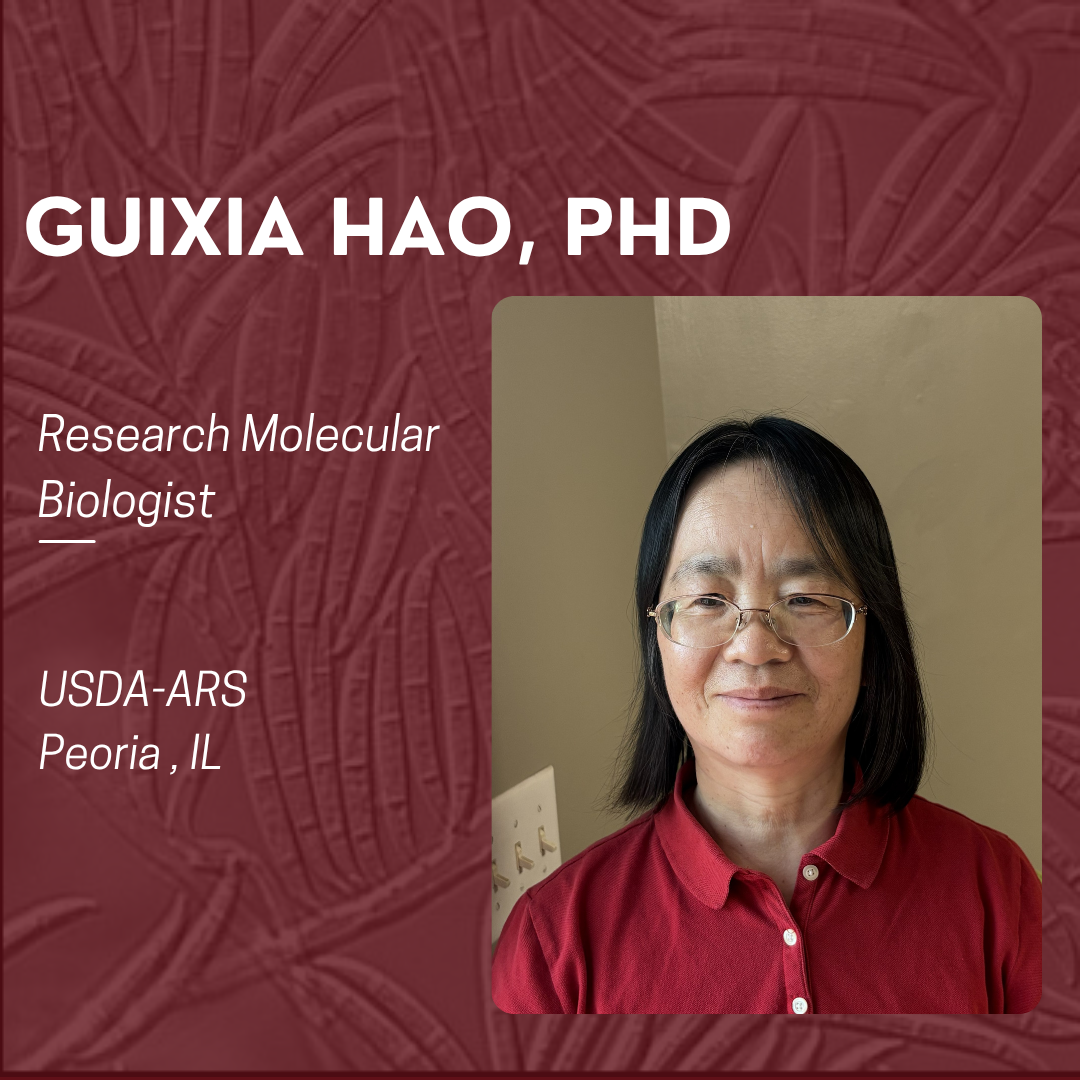
Meet Guixia Hao, a research molecular biologist with the USDA-ARS National Center for Agricultural Utilization Research, Mycotoxin Prevention and Applied Research Unit in Peoria, Illinois. Hao has received funding from the U.S. Wheat and Barley Scab Initiative (USWBSI) since 2018. Her USWBSI-funded research spans the Pathogen Biology and Genetics (PBG) and Gene Discovery and Engineering Resistance (GDER) Research Areas and focuses on characterizing genes that affect Fusarium head blight (FHB), as well as exploring RNA interference (RNAi) and biocontrol approaches for managing the disease and reducing mycotoxin contamination. She currently serves as the USWBSI’s PBG chair. And in 2025, she was awarded the USWBSI’s Outstanding New Investigator Award.
Finding Roots in Plant Genetics and Disease Research
Hao received her bachelor of science degree in biology from Shandong Normal University and her master of science degree in plant genetics and breeding from Beijing Agricultural University, where she studied hybrid vigor and crossing strategies to improve grain quality. She then earned her doctoral degree in plant genetics and breeding from the Beijing Forestry University, where she worked on introducing a natural insect-resistant gene into the Peking poplar, a fast-growing tree valued for its timber.
After completing her degrees, Hao moved to the United States to take a postdoctoral research position at Cornell University, where she studied grape crown gall disease. She later completed a second postdoctoral position at the USDA-ARS Horticultural Research Lab in Ft. Pierce, Florida, where she conducted research on citrus greening, a serious disease affecting orange, lemon, and grapefruit trees.
Throughout her career, many mentors and colleagues influenced and supported Hao’s development as a scientist. However, she is particularly grateful to Thomas Burr, her postdoctoral advisor at Cornell University, whose guidance and encouragement continued well beyond Hao’s time in his laboratory.
In 2016, Hao relocated to the USDA-ARS Mycotoxin Prevention and Applied Microbiology Research Unit to become a research molecular biologist. There, she began studying Fusarium graminearum, a pathogen of wheat and barley, with a focus on understanding the molecular factors that make the fungus such an effective pathogen.
Targeting Fungal Virulence to Reduce FHB and Mycotoxins
Hao values being part of the USWBSI because of the highly collaborative and supportive community it fosters. During her years of involvement with the Initiative, she has had the opportunity to work closely with many colleagues, including Harold Trick, with whom she developed numerous transgenic lines expressing Fusarium graminearum TRI101 and optimized their performance. She also collaborated with Shengming Yang, who generated barley RNAi lines targeting TRI5, the first gene in the trichothecene biosynthesis pathway.
Although it is difficult for Hao to choose a favorite FHB-related project, she is particularly enthusiastic about efforts to identify genes and proteins essential to Fusarium graminearum pathogenesis. By defining critical virulence factors, researchers may be able to target them to reduce fungal infection and, in turn, limit deoxynivalenol (DON) contamination in the grain. “This work not only advances our understanding of the molecular basis of Fusarium head blight but also supports the development of strategies to protect crops and improve food safety,” said Hao.
When it comes to FHB, Hao considers her identification of the first Fusarium graminearum effectors, which play an essential role in fungal pathogenesis, to be her most significant accomplishment. She has also contributed to several other important research advances, including identifying effectors that function in fungal spread throughout the wheat head and demonstrating that the newly discovered mycotoxin NX functions similar to DON by promoting fungal spread and contributing to early-stage infection.
In addition, Hao’s research has explored targeting the Fusarium graminearum TRI5 gene through RNAi to reduce toxin contamination. Her work also investigated leveraging the fungal self-protection gene TRI101 to enhance FHB resistance in three wheat varieties. Together, these approaches have resulted in mycotoxin accumulation reductions of more than 90% compared to the wild-type parents.
Hao expects Fusarium graminearum to remain a major challenge for wheat and barley producers. Pathogen populations can evolve rapidly, and the combination of increasingly extreme weather conditions and heavy reliance on fungicides may contribute to the emergence of more aggressive strains and potentially new mycotoxins. “Addressing these threats will require continued development and implementation of novel, effective, and sustainable control strategies to better protect growers and maintain grain quality and safety,” said Hao.
Building a Career through Curiosity, Adaptability, and Collaboration
Hao encourages graduate students and postdoctoral researchers to plan each experiment carefully while remaining adaptable when outcomes do not go as expected. “Fusarium head blight is a challenging disease to work with, in part because plant growth and disease evaluation require significant time, and results can vary widely among plants and from one experiment to the next,” said Hao.
She emphasizes that failures are an inherent part of research and can often lead to important discoveries. Hao also encourages early-career professionals to expand their skill sets, remain curious, and build strong professional networks, which can support long-term success in their fields.
Hao presented at the GPFHB (Graduate Students and Post-Docs) in FHB Fall Webinar on September 16, 2026 and the recording is now available to view. You can also catch her at the 2026 National Fusarium Head Blight Forum on December 8 in Louisville, Kentucky.
For more information about Dr. Guixia Hao's research, visit her profile page.
To learn more about others in the FHB community, check out all the previous USWBSI Featured Researchers/Advocates.