
Featured Researcher Bio - Andrew Green 2026
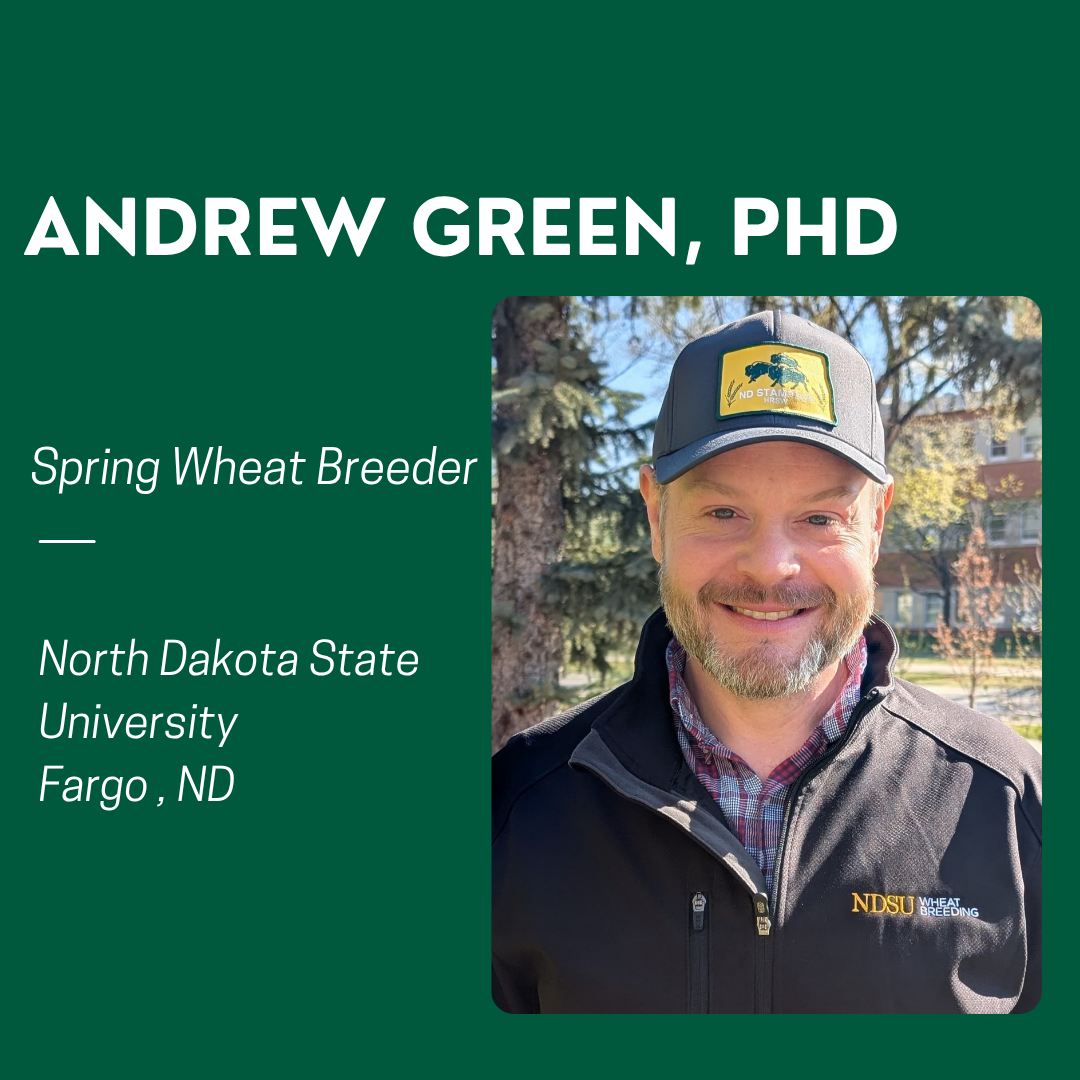
Meet Andrew Green, an associate professor and the spring wheat breeder at North Dakota State University. Green has been funded by the U.S. Wheat and Barley Scab Initiative (USWBSI) since 2016. His USWBSI-funded research is part of the Variety Development and Host Resistance Spring Wheat Parents Coordinated Project and focuses on developing hard red spring wheat cultivars with improved resistance to Fusarium head blight (FHB). He is a past chair of the USWBSI’s VDHR-SPR Committee and served on the Steering Committee.
Building on Curiosity and Applied Research
Green grew up in Missouri. After graduating from high school, he attended Truman State University in Kirksville, Missouri, where he studied agriculture. There, he worked with his first plant breeder, Mark Campbell, on his corn breeding project. Campbell’s curiosity and desire to develop a useful product showed Green how research could provide an opportunity to make a difference in the world.
During his time with Campbell, Green worked on high-amylose corn starch and he led a project using scanning electron microscopy to analyze starch morphology in longitudinal sections of mutant corn lines. He then spent a summer working with Luther Talbert at Montana State University in Bozeman, Montana. This was Green’s first exposure to a public breeding program at a land-grant university working to solve applied agricultural problems.
After completing his undergraduate degree, Green attended Virginia Tech and completed his M.S. degree under the guidance of Carl Griffey. There, he worked on yield improvement and changes in yield components of soft red winter wheat, using data collected from 1959 to 2009. For his doctorate, he moved to Kansas State University, where he worked with Allan Fritz on heat and drought stress tolerance from the tertiary gene pool.
As part of this work, Fritz and Green built drought-stress screening columns with automatic irrigation based on matric potential of the growing media. The system simulated precise drought conditions, as measured by volumetric water content and matric potential at four depths along a 5-foot column.
In 2016, Green joined North Dakota State University and took over leadership of the spring wheat breeding program, which has been in existence since 1916, when L.R. Waldron started the program. In this position, Green oversees a breeding process that typically takes seven to 11 years, from that first hand cross to a variety release decision. His team, which includes Green and five full-time research technicians/assistant breeders, test varieties in 27 to 30 environments across the state and evaluates roughly 1,400 lines from hundreds of breeding populations.
Breeding for Yield, Quality, and FHB Resistance
As a breeder, Green’s main goal is to increase farmers’ revenue at the elevator while minimizing discounts on their grain. To do that, he works to combine high yield with FHB resistance while selecting varieties with acceptable protein content and test weight for farmers to grow.
In his breeding program, Green is trying different ways to collect more data accurately and in less time. One of his favorite improvements has been the adoption of visual imaging of Fusarium-damaged kernel (FDK) scores. “This data is far more informative, accurate, and efficient than visual scores and has aided early selection decisions while we await DON data,” said Green.
If Green can continue to adopt new tools to the help increase farmers’ revenue by minimizing inputs and maximizing yield without giving up ground to FHB over the course of his career, he will consider this his biggest accomplishment.
As part of the USWBSI, Green enjoys getting together with colleagues at the National Fusarium Head Blight Forum. If everyone operated in a silo, research could become redundant, stagnant, or even biologically inaccurate. By collaborating with others in the community, FHB research can advance through strong relationships between breeders and plant pathologists. The NFHB Forum provides an opportunity for individuals to make these connections and help move research forward.
If we never saw Fusarium damage on a wheat head again, Green would be very happy. “I think with continued adoption of best management practices, the impact of FHB for farmers and the food supply can be greatly diminished,” said Green.
On the breeding side, Green hopes as more novel technologies evolve and become adopted, breeders can find effective ways to eliminate the risk of FHB. However, Green doesn’t believe the risk will ever be zero.
Learning from as Many People as Possible
According to Green, everyone has their own way of doing things, and there might not be a single right or wrong way. For instance, there are many ways to get to an inbred line. He encourages new scientists to not accept “this is how it’s always been done” as a justification for how to do something.
“You should know and have done every job in your program to know whether what you are asking is reasonable,” said Green.
Giving Farmers a Reason to Grow Wheat
Green will be presenting at the 2026 National Fusarium Head Blight Forum on Wednesday, December 9, 2026 in Louisville, Kentucky. His presentation, titled “Good is Good Enough – Prioritizing FHB Resistance in Uncertain Times,” will examine how breeding programs are reflecting the appropriate level of resistance and whether current trials are being managed similarly to how a farmer would manage their fields.
At a time when wheat acreage is decreasing and production is historically low; a critical look at breeding priorities may be in order.
For more information about Dr. Andrew Green's research, visit his profile page.
To learn more about others in the FHB community, check out all the previous USWBSI Featured Researchers/Advocates.