
Featured Researcher Bio - Eric Olson 2026
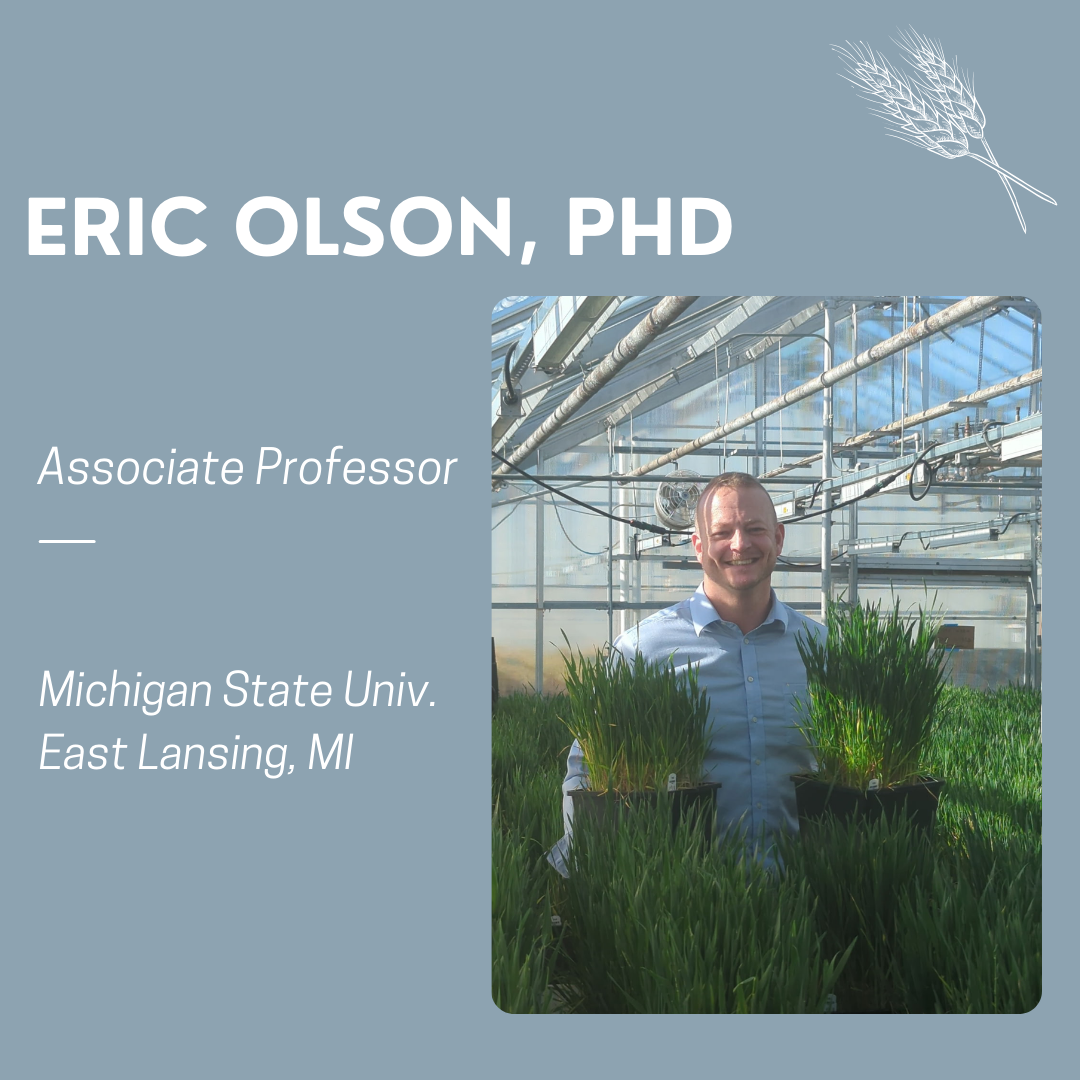
Meet Eric Olson, an associate professor of small grains genetics in the Department of Plant, Soil, and Microbial Sciences at Michigan State University. Olson has been funded by the USWBSI since 2013. His research focuses on developing FHB-resistance soft red and soft white winter wheat varieties for Michigan and the broader eastern soft winter wheat growing region.
Drawing Inspiration from Farming
Growing up, agriculture was a large part of daily life for Olson, who was raised on a small dairy farm in Wisconsin. He attended the University of Wisconsin-Platteville, where be obtained his B.S. in biology, and began studying plant-pathogen interactions in the moss rust parasite Eocronartium. His interest in improving plants deepened during his M.S. degree at North Carolina State University where he worked with Gina Brown-Guedira in the USDA Small Grains Genotyping Lab mapping genes and identifying markers that predict disease resistance. Following his time at NC State, Olson had the opportunity to work with a group of very talented scientists using wheat wild relatives to improve disease resistance while exploring new genetic diversity during his PhD at Kansas State University.
Olson draws inspiration from his farming background. Growing up on a small farm showed him the importance of rural agricultural economies. When a farmer sees a profit, they will invest in their farms which is an investment in the economic well-being of the community that helps to maintain jobs and creates a tax base that supports schools and other infrastructure. In addition, he is inspired by the pioneer, Edgar McFadden, whose breakthroughs in wheat genetics demonstrated the profound value of wild relatives in modern breeding.
Collaborating on a Common Goal
Olson believes the USWBSI is unique in that it brings together researchers, growers, and stakeholders such as millers, maltsters, and other industry representatives, to work on a common goal: reducing FHB and its mycotoxins in wheat and barley production. This shared purpose drives innovation and ensures that the research being conducted translates directly into improved resilience for farmers and the food chain.
His favorite project is difficult to pin point but, Olson enjoys using genomic predictions to advance planting breeding for FHB. With this technology, breeders are able to deliver resistant varieties to the marketplace faster than ever. In addition, he enjoys working with other researchers to find ways to automate large-scale phenotyping of FHB. In the meantime, he and his team work diligently every year to rate visual FHB resistance and provide the information along with DON accumulation on a number of commercially available wheat varieties to farmers in Michigan.
As a public plant breeder, Olson has the flexibility and responsibility to be innovative. He and his team are willing to take risks and try new methods to approach persistent challenges in breeding for FHB resistance. One of his biggest accomplishments has been the drive to integrate genomic and phenomic platforms to improve prediction accuracy for FHB resistance into his breeding program.
Over the next 20 years, Olson believes that FHB will remain a challenge for farmers. Climatic projections suggest increased precipitation which raises the likelihood of epidemics. “The pathogen is deeply entrenched in production systems, meaning our success depends on consistent research, durable resistance sources, and sustainable funding to ensure growers continue to have reliable, profitable wheat and barley options,” said Olson. An impactful form of research is developing moderately resistant varieties that can replace those that are susceptible within the marketplace. The rate of susceptible varieties being released has drastically decreased. Thus, Olson is hopeful this cycle will continue in the coming decades to where FHB resistance is fixed across breeding programs and variety lineups.
Taking Risks and Remaining Focused
Olson believes young researchers should seek out collaboration actively. The most effective research isn’t carried out by one individual but is solved by team science, especially when solving problems as significant as FHB. In addition, he recommends always embracing innovation. “Take risk and keep up the pace towards your goals,” says Olson. Finally know that your work matters. Staying focused on the broader impacts for farmers, industry, and policy makers drives success.
For more information about Dr. Eric Olson’s research, visit his faculty page.
To learn more about others in the FHB community, check out all the previous USWBSI Featured Researchers/Advocates.