
Featured Researcher Bio - Ashley McFarland 2026
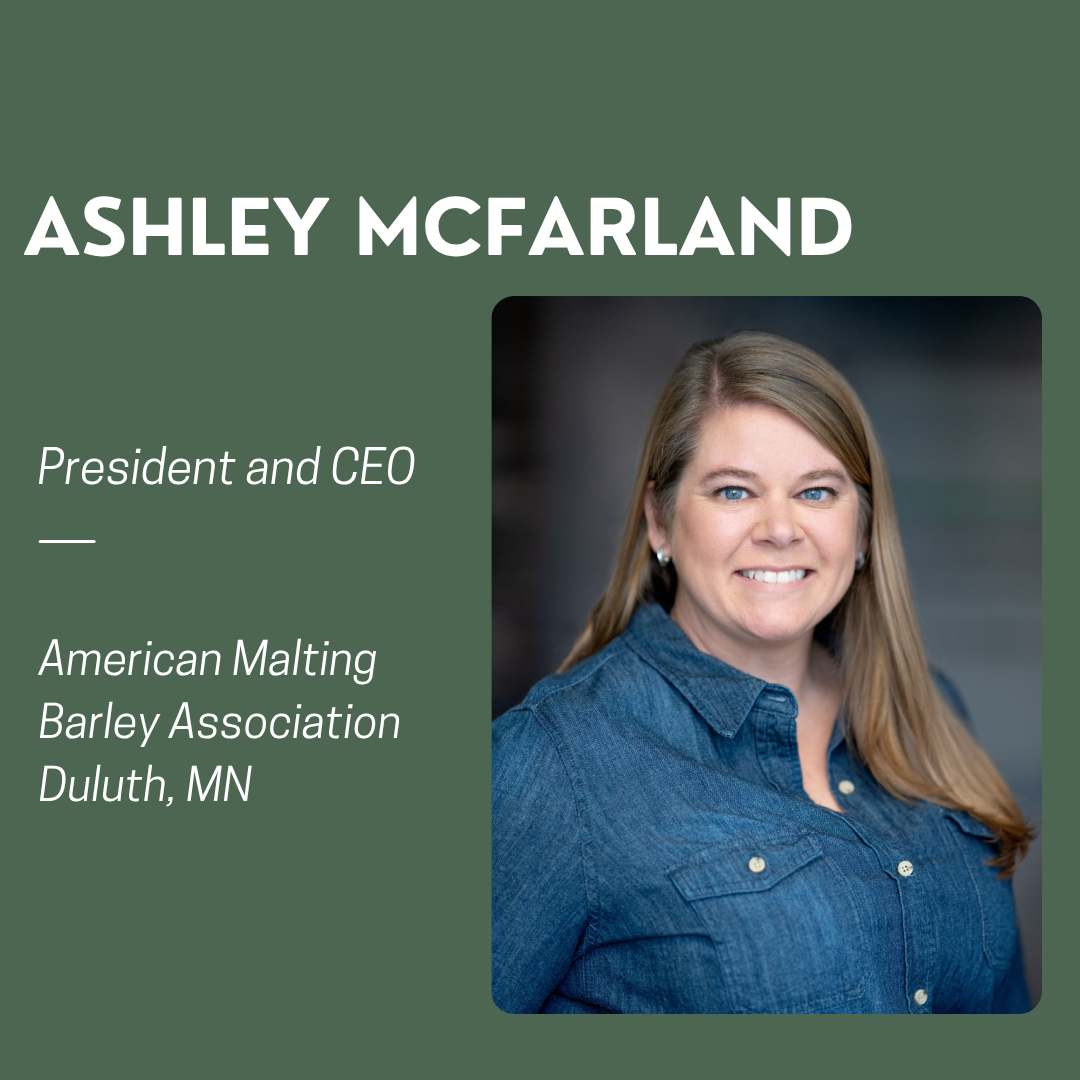
Meet Ashley McFarland, president and chief executive officer (CEO) of the American Malting Barley Association (AMBA), a trade organization representing barley malt producers and users with the sole purpose of ensuring a resilient and high-quality supply of malting barley for their products. McFarland joined AMBA almost five years ago as the Technical Director and recently transitioned into the role of President and CEO in January. In addition, she recently was elected to serve as a member of the USWBSI Executive Committee.
Shaping a Career in Conservation, Research, and Agriculture
McFarland grew up on a dairy farm in northeast Iowa. While her family didn’t produce much barley, she’s always been passionate about agricultural systems and her roots played a huge role in her career path. Throughout her childhood she was very active in 4-H, Future Farmers of America, and the promotion of the dairy industry and loved translating science to farmers or the industry. After graduation, McFarland attended Central College in Pella, Iowa with an interest in pre-law, hoping to support farmers navigating the evolving changes in environmental regulations. But she ultimately decided she wanted to work more directly with farmers and graduated with a bachelor of arts double majoring in political and environmental science.
Her education continued at Iowa State University, where she received her master of science in environmental science-water resources. Her goal was to work for the Natural Resource Conservation Service, with the hopes of supporting on-farm conservation practice adoption. Her thesis explored leveraging emerging geospatial conservation practices to support water quality improvements. It was very rewarding for her to see this work ultimately be used to inform a large watershed improvement project in central Iowa.
She started her career in Cooperative Extension for the University of Idaho and then moved to the Upper Peninsula in Michigan where she served as the Director of the Michigan State University Upper Peninsula Research and Extension Center. As the director, she managed a diverse research portfolio spanning across multiple agricultural sectors. During this time, she developed a research program around small grains primarily focused on serving the craft beverage industry in the state. This ultimately led to a statewide applied research program, diverse outreach and education efforts targeting stakeholders, and the establishment of the annual Great Lakes Hop and Barley Conference. Through these efforts, McFarland became very active in the national efforts to strengthen malt barley as a crop, and actively participated on the National Barley Improvement Committee (NBIC).
Eight years ago, McFarland and her family moved to Duluth, Minnesota. After some time at the University of Minnesota and doing environmental non-profit work, she had the opportunity to join AMBA and has been with the organization since the fall of 2021.
Giving Farmers a Voice Through Advocacy
McFarland started her journey in advocacy while at Michigan State University. Mike Davis, past president of AMBA, initially introduced her to the USWBSI, but it was the aspect of working with farmers through NBIC that really sparked her passion for the work. For McFarland, it is rewarding and humbling to hear farmers speak about the impact the USWBSI’s research has had on their operations, livelihoods, and ability to grow barley and wheat despite FHB’s greatest efforts to take it out. Even today, she enjoys being on Capitol Hill with farmers, speaking about what life in the 1990’s was like when FHB wiped out entire crops. But because of USWBSI efforts, these farmers were able to overcome and reincorporate small grains back into their crop rotations.
Along with advocacy, McFarland loves being involved in many elements of the barley supply chain. By being surrounded by passionate researchers focused on barley improvement, she is constantly learning and working to translate their information to gain support. She also enjoys pulling a diverse industry together through a trade association to allow critical issues that members are facing to coalesce. Finally, doing work that is important to farmers and rural America is important to her. “At my core, I am a farmer’s daughter, and if the work I lead can make farming a bit easier, a bit more profitable, and keep farmers farming a bit longer, it’s all been worth it,” said McFarland.
As an advocate for FHB research, she believes her biggest accomplishment was to obtain the FY25 funding for the USWBSI. McFarland, along with Molly Miller from the North American Millers’ Association, attempted several times to positively influence the rollout of funding. While it’s hard to pinpoint what method exactly worked, ultimately getting the USWBSI funding distributed and fully appropriated felt like a win.
Building Connections and Making an Impact
For early career professionals and graduate students McFarland recommends intentionally investing in relationships. “Every job I have landed can be attributed back to a previous relationship that provided a connection to a future role,” said McFarland. After moving several times and changing jobs over the past 20 years, she knows the world is incredibly large and small at the same time. She recommends finding ways to connect research to real world applications, and know the farmers who will ultimately benefit from the work. Not only will this make the research more rewarding, but it will also make it easier to garner support when needed.
For more information about Ashley McFarland and her advocacy work, visit the American Malting Barley Association website or reach her via email.
To learn more about others in the FHB community, check out all the previous USWBSI Featured Researchers/Advocates.